THE SEVENTH MATERIAL · INNOVATION
30 years of measured retention. 20 minutes to change shape.
The Seventh Material is tested on two fronts: how well it holds, and how easily it comes apart. This page gives the tests, the figures and the buildings. It does not argue the case.
What is measured, and what comes apart.
Durability and adaptability normally pull against each other. A material that lasts is hard to change. A material that changes easily does not last. The Seventh Material holds both, and both are measured.
Design life runs from twenty to forty years, depending on the range and the exposure. After thirty years in service, a TX30 membrane retains more than 65% of its tensile strength. At the other end of the same property: a ten thousand square metre retractable roof takes a stadium from open air to closed arena in twenty minutes.
What follows is the evidence for both.
Designed for 20 to 40 years.
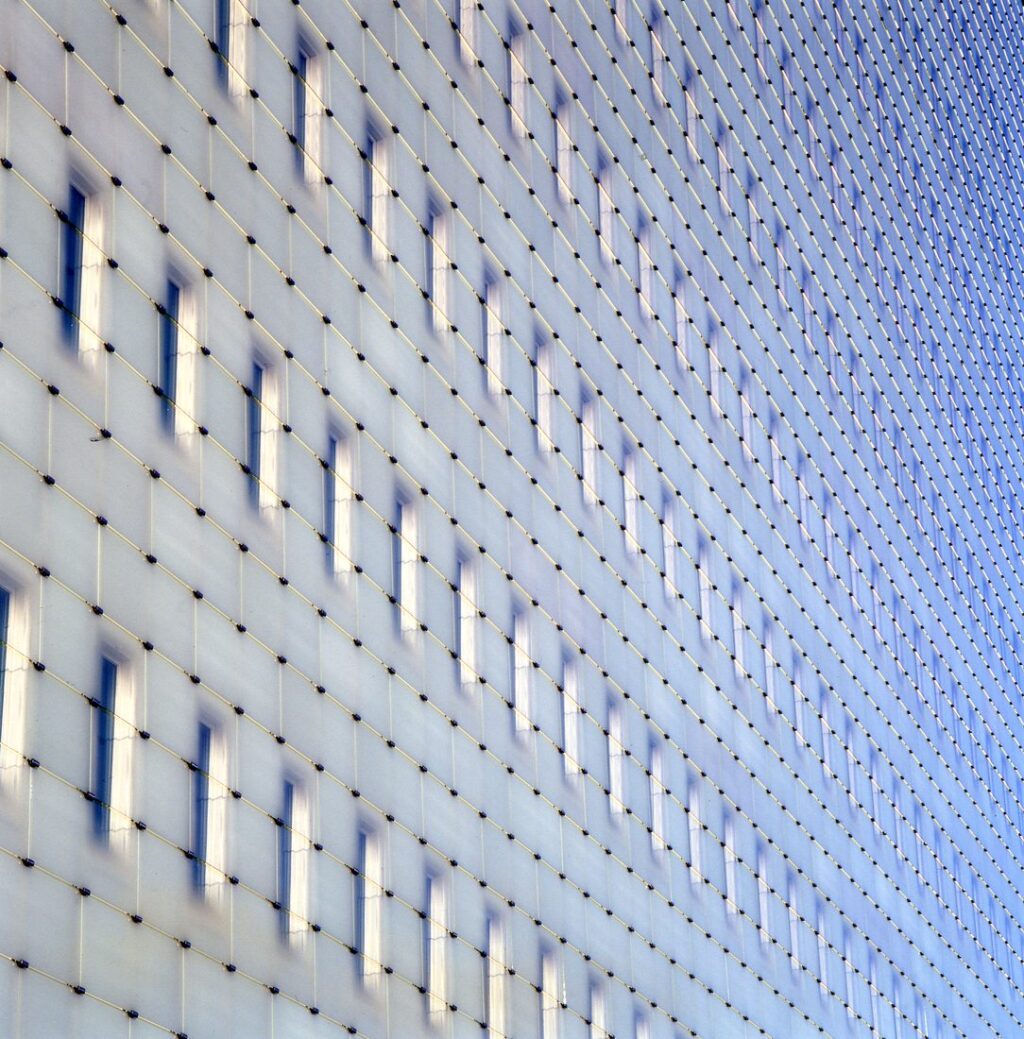
A membrane in this category is designed for twenty to forty years of service. Where a project falls in that range depends on the product, the exposure and the configuration, and the design life should be established for the building rather than read off a page.
Two measured points sit inside that range.
After thirty years of exposure, a TX30 membrane retains more than 65% of its tensile strength and holds its surface properties.
PTFE-coated glass fibre carries a fifteen-year warranty.
Durability is measured, not assumed.
Ageing is simulated in a chamber against an established equivalence: 2,500 hours of accelerated testing corresponds to ten years of natural exposure in Florida.
Colour is tracked three ways in parallel, because no single method is sufficient on its own. Artificial UVA simulation to ASTM G154. Natural exposure at sites in different climate zones. And monitoring of real buildings already in service.
Dimensional stability is measured as elongation under load.
The polyester reinforcement is covered by the coating rather than exposed by it. That is a direct consequence of the Précontraint® process, and it is the reason the thirty-year figure above exists at all. The mechanism is explained under Technical capability.
For interior ceiling membranes, impact resistance is tested to EN 13964 Annex D – thirty-six shots at 60 km/h – with class 1A achieved.
7 buildings. 7 conditions.
A laboratory result establishes a property. Buildings establish a range. Each of the following answers one condition, in service.
- Telenor Arena · Oslo, Norway · winter service, −21 °C recorded.
- Pacific Club · Hong Kong · inflatable structure designed for 200 km/h wind.
- Rodeo arena · Florida, USA · designed for 250 km/h wind.
- Cable car station · La Plagne, France · 2,125 m altitude · FLEXLIGHT 602.
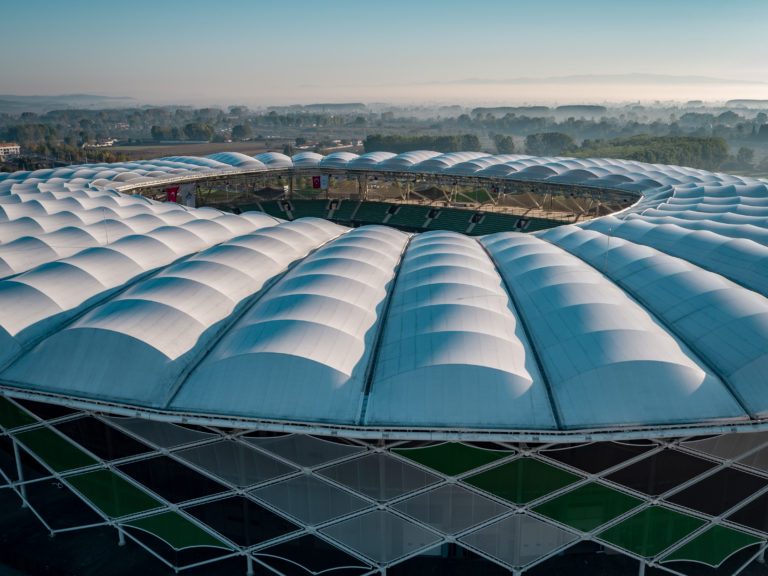
- Stadium · Turin, Italy · colour held for 14 years · TENSEO Advanced 1302 S2.
- Grandstand, Runaway Bay · Gold Coast, Australia · 10 years without cleaning.
What the list shows is the range the category covers, and where to look for the specification that matches your own site.
These are separate buildings, each meeting one condition. No single membrane has met all of them, and it would be wrong to imply that it has.
The membranes that carry this service life.

Made in a workshop, not on a roof.
The Seventh Material is prefabricated off site. PTFE-coated glass fibre welds cleanly and is worked in wide panels, which reduces the number of seams a building carries and makes fabrication economical.
Most of the labour moves into a controlled workshop. What happens on site is deployment and connection, so the programme is shorter and less of it is exposed to weather.
A new skin on an existing building.
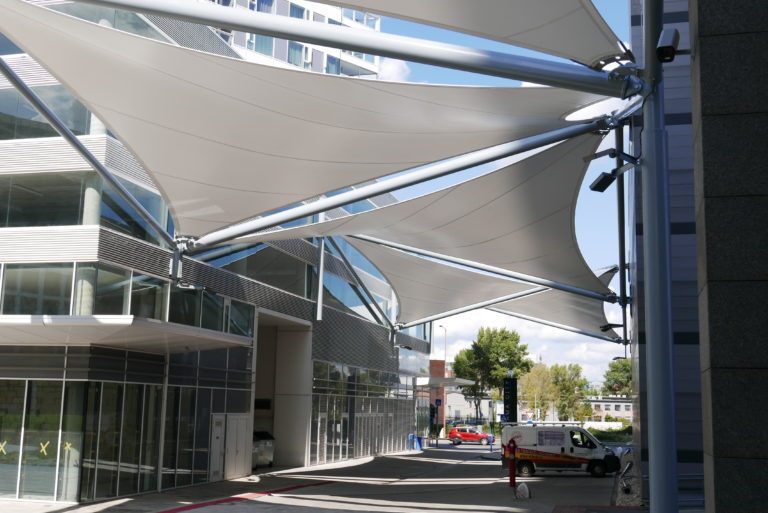
Lasting is not enough on its own. The Seventh Material is compatible with other materials and installs on new build and refurbishment alike. On a façade it allows a re-skin: a new envelope over an existing structure, without demolition.
That matters most where it is least visible. A building whose use is changing, whose envelope has failed but whose frame has not, or which cannot be taken out of service, can be re-clad rather than replaced.
UNEP reports that half of the buildings that will exist in 2050 are still to be built or renovated (Global Status Report for Buildings and Construction 2025-2026).
The category’s strongest environmental argument is not that it is light. It is that it lets a building stay.
What goes up can come down.
A ten thousand square metre retractable roof moves a stadium from open air to closed arena in twenty minutes.
At the scale of a site, off-site prefabrication shortens the programme. At the scale of a component, the material is modular and repairable: a panel can be replaced without dismantling the assembly around it.
Light, reversible, repairable. What is made this way can be unmade.