
Tokyo
Japan
Serge Ferrari Group wraps Building of Music in Tokyo
Building of Music is a new development completed in 2022 in the Kanda-Ochanomizu district of Tokyo, Japan. Steeped in centuries of history and a wealth of culture, today the area is famous for its surprising concentration of music stores. And nowhere is this more striking than on ‘Guitar Street’, home to scores of shops entirely dedicated to guitars and other string instruments. As such, the Kanda-Ochanomizu district has become a favourite stamping ground among many musicians and is also a popular meeting place for students and intellectuals, with several prestigious universities based nearby. This unique mix has contributed to the neighbourhood’s youthful, dynamic and innovative vibe.
Building of music: a celebration of music in the heart of Tokyo
Building of Music was commissioned by Miyajishokai Co. Ltd, a Japanese heritage company specialising in the sale of musical instruments, gear, and sheet music for both professionals and amateurs. From the 1st floor to the 8th floor, the project incorporates lesson rooms, rehearsal rooms, recital halls, storage facilities, a shop and offices. The building’s design was developed with particular attention to the acoustics of the various spaces and materials used, to ensure seamless sound quality within the structure, both for recordings and live performances.
In addition, the architectural concept also placed emphasis on sustainability, with the use of light, reusage and easy-to-maintain materials to honour the City of Tokyo’s commitment to sustainable construction.
Embodying music in architecture
The design concept was ideated by the teams at Japanese architecture firm, Aisaka Architects’ Atelier, who envisioned a building with a form that would reflect its purpose.
Their guiding principle was to create a specific place to celebrate musical creation on the one hand, and the experience of music on the other. Also central to the design was responding to the building’s surroundings — the Kanda-Ochanomizu district — and its deep-rooted connection with music.
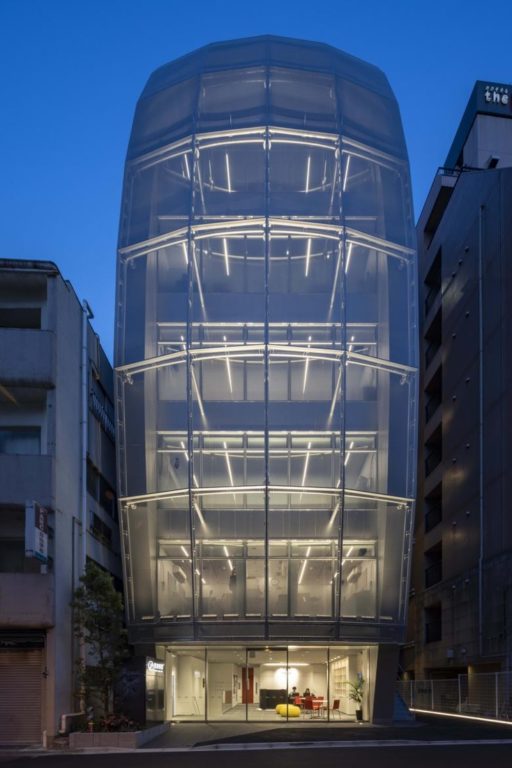
Another factor that informed the architecture was the plot’s thin and elongated shape, which the architects had to take into account and incorporate into their creative process. The result is a design freely inspired by a piece of musical equipment: a giant speaker filling the street and the entire neighbourhood with music. The resemblance is further accentuated by the use of an architectural membrane to cover the building’s facade, enhancing the illusion.
Pulling the design together with Tenseo Frontside 381
To complete the facade, Aisaka Architects’ Atelier chose one of Serge Ferrari Group’s technical membranes — Tenseo Frontside 381. This solution, installed by Makmax, provides the finished design with a seamless look.
Tenseo Frontside 381 — formerly Frontside View 381 — is a creative technical fabric that brings a unique personality to each construction. This flexible material offers designers a great deal of creative freedom to play with light and bring volumes to life. And its light weight and large mesh weave ensure lower structural loads and susceptibility to wind.
Also noteworthy, Tenseo Frontside 381 plays an important part in the building’s thermal design, as it blocks up to 78% of the sun’s heat. The result is a direct positive impact on air conditioning costs, cutting spending by about 30%. This is what makes Tenseo Frontside 381 the perfect solution for developers and designers looking to reduce the environmental footprint of buildings with no compromise on aesthetics and performance. Lastly, it also regulates the flow of natural light, effectively reducing glare and improving visual comfort indoors, while maintaining complete visibility to outside.
Building of Music is a unique project, made distinct both by its shape and use of materials. And it’s no wonder that the building was shortlisted for a Japanese award recognising outstanding tensile architecture designs.
Project Participants
Architect: Aisaka Kensuke, Aisaka Architects’ Atelier
Client/Installer: Makmax
Copyright: Shigeo Ogawa