
Düsseldorf
Germany
Tensile Roof at Messe Düsseldorf Exhibition Centre
ABOUT
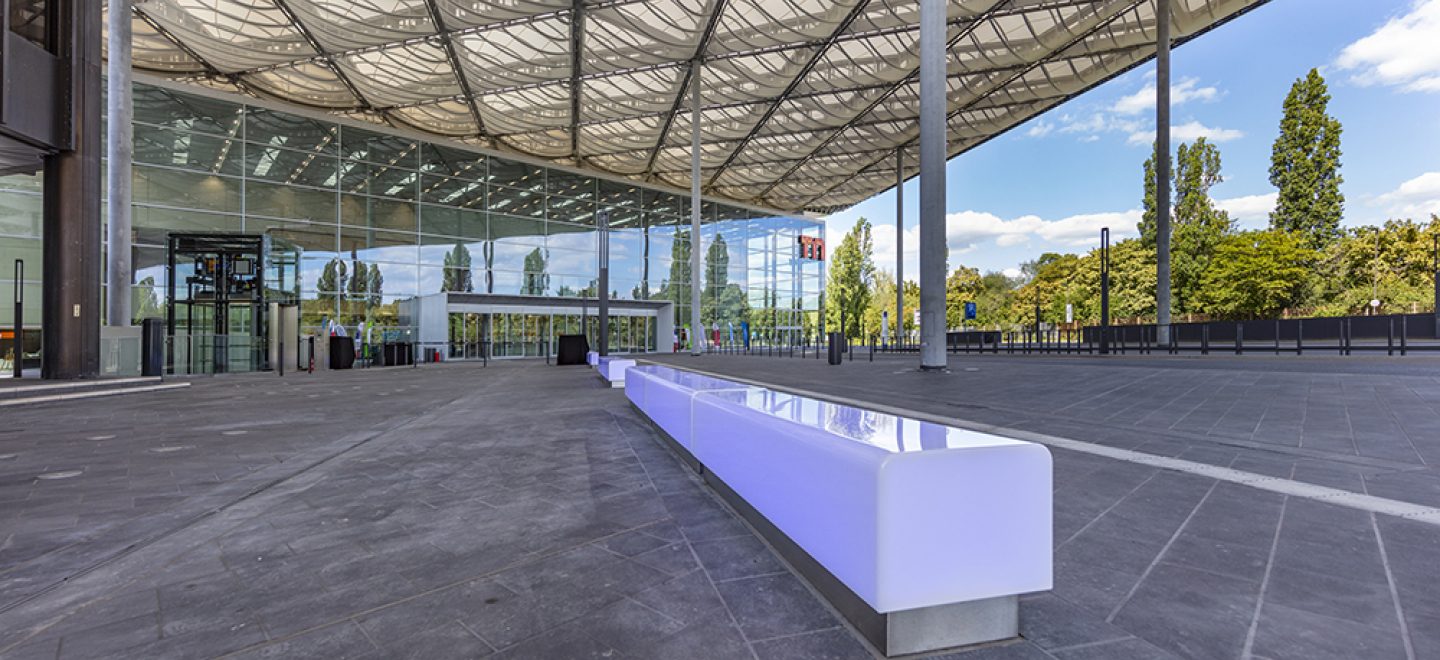
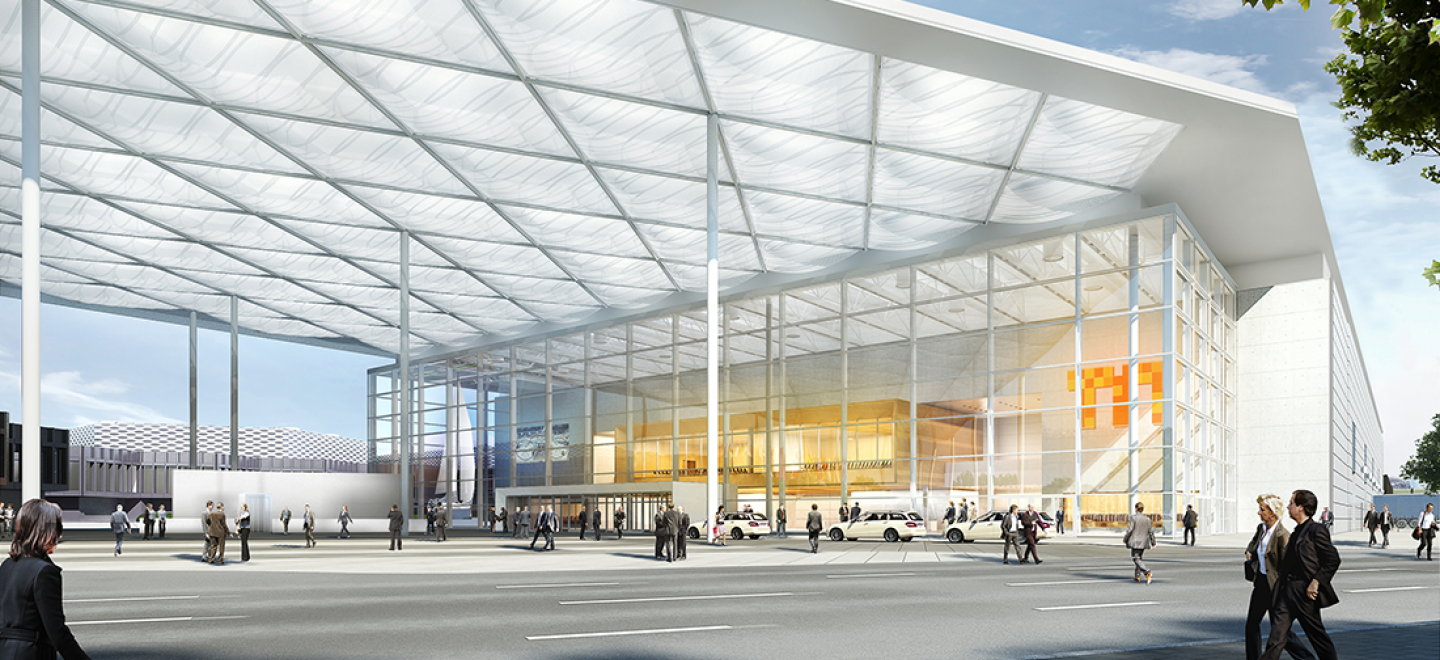
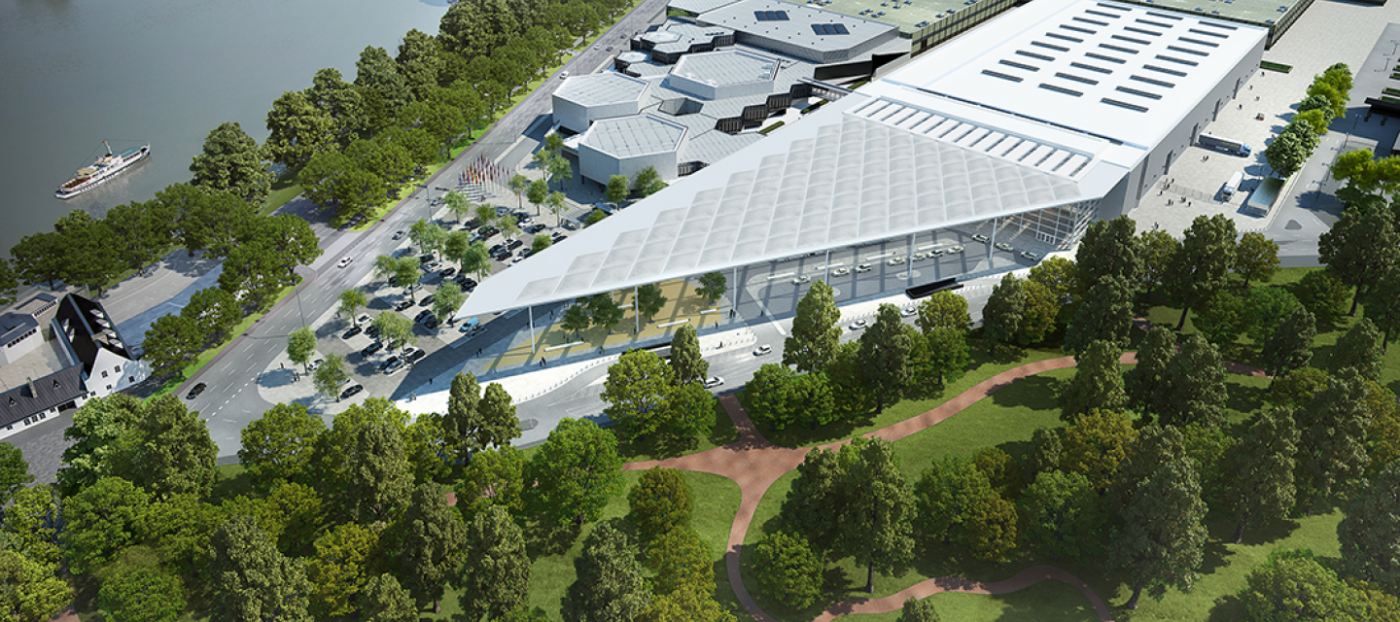
Sheltered by a translucent, 7,800-sqm canopy designed by the architecture practice Slapa Oberholz Pszczulny (SOP) Architekten, the new south entrance of the Messe Düsseldorf exhibition centre is a distinctive landmark visible from the city across the Rhine.
Suspended 20 meters overhead, this new architectural statement links the iconic south forecourt to the multifunctional spaces behind the glass facade of Hall 1, combining a variety of functions. This vast roof structure is wrapped in two materials supplied by Serge Ferrari Group, which once again demonstrates its commitment to ‘Act now to build a better tomorrow’ through innovative and resource-saving architecture.
A new architectural landmark for the south entrance of the Messe Düsseldorf
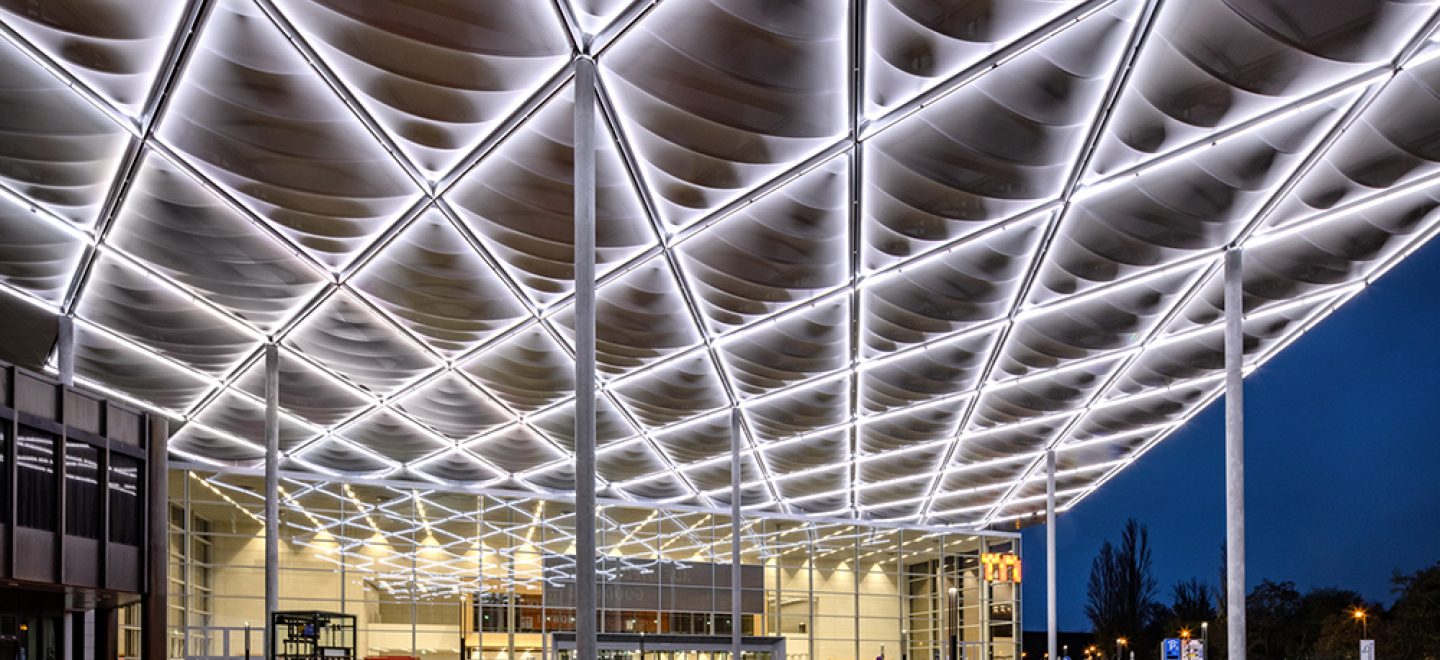
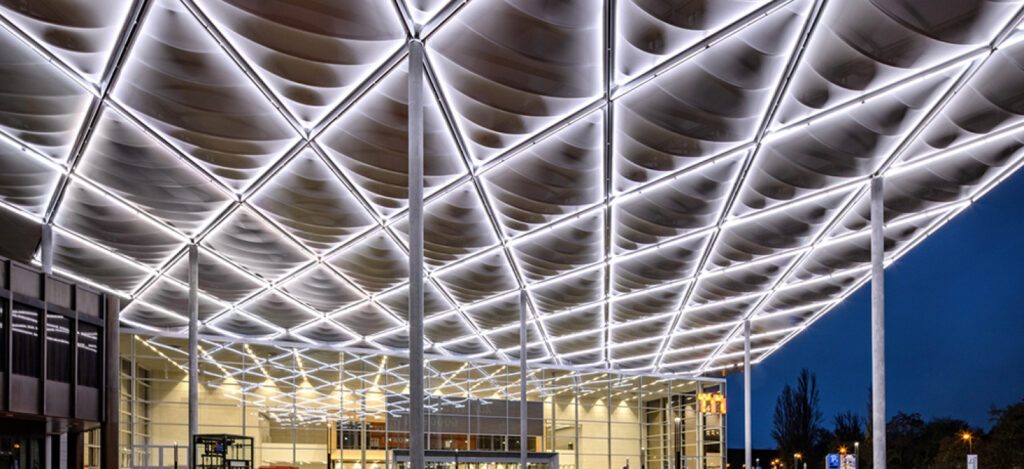
Extending 170 meters in length and 93 meters in width, the polygonal canopy provides a dynamic architectural statement evoking the shape of the exhibition centre’s grounds. The roof structure features a network of diamond-shaped air cushions made of translucent fibreglass fabric to bring the design to life. But the material truly reveals its stunning aesthetics at night, when linear LED lighting illuminates each cushion.
The pursuit of light-filled weightlessness
One of the priorities for this gigantic canopy project was to avoid large areas of opaque materials to bring in plenty of natural light. From a fire safety point of view, it was also crucial to make sure that all the materials were non-combustible,’ says Jörg Bredenbröcker, project manager at SOP Architekten. Only two materials allowed enough light to filter through, offering possible solutions to this challenge: glass — too heavy and expensive — and textile membranes. Although ETFE air cushions would have been satisfactory in terms of transparency and design, they were ruled out for reasons relating to fire safety and cost. So the architects opted instead for PTFE fabrics manufactured by Verseidag, which have received a Euroclass A2 rating: a closed fabric dressing the top part of the structure, combined with a PTFE mesh fabric for the underside. Another affordable and easy-to-install solution had also been selected by the design team: Serge Ferrari’s Tenseo Frontside 381 PVC mesh fabric.
This technical solution made installation easier and therefore more economical:
a) fewer risks of wrinkling than with fibreglass fabrics;
b) possibility to install even at temperatures below 50°C”.
An inexpensive solution based on fire prevention simulations
The decisive factor for the choice of materials however proved to be the Euroclass B-s2, d0 rating. The architects felt it was essential to create a design that was not only aesthetically pleasing, but also technically flawless to provide the client with a solution that was both sustainable and inexpensive. To that end, the project team at SOP Architekten consulted fire prevention specialists. The behaviour of the 20-meter-high structure was assessed using computer-generated simulations and evaluated by fire brigade experts. The research confirmed that it was possible to use Tensep Frontside 381 PVC mesh fabric for the underside of the structure, as the simulation showed that in the event of a fire, any molten PVC drippings would evaporate before they reached the ground.
This was excellent news to us, because the material was really what we were looking for in terms of aesthetics and light transmittance, and its fouling behaviour seemed compatible with use on the underside of the structure, where it would not be exposed to the weather. The most common risk associated with highly translucent closed PVC fabrics is that over time polyester fibres tend to become brittle as a result of UV radiations. So this solution reduces risk to a minimum for maintenance staff,’ explains Jörg Bredenbröcker. This is made possible in part by the unique properties of the fabric itself, which consists of a thick yarn structure woven with the Précontraint technology and finished with a layer of acrylic coating, but also by the openness factor of the mesh fabric. This configuration guarantees optimal resistance of the polyester fibres against UV rays. ‘The combination of these two Serge Ferrari materials provides an effective solution in terms of durability and ease of maintenance for the upper part of the structure, while also meeting aesthetic and economic criteria,’ as pointed out by Jörg Bredenbröcker.
A construction featuring diamond-shaped air cushions
During the design phase, the team looked for simple solutions to reconcile design, static performance, accessibility, water drainage and maintenance. The solution they came up with is a metal lattice structure resting on 19 spun concrete posts. Facing upwards and downwards on either side of the air cushions, two series of eight tubular profile arches create the distinctive fish-belly curvature on which the membranes are stretched.
A highly resistant upper membrane, even against aggressive environmental influences
The main concern when opting for a tensile roof is about the material’s resistance to weather conditions and corrosive substances, including bird droppings and kerosene residues due to intense air traffic from Düsseldorf airport nearby. Another challenge was to find a fabric that would ensure minimal loss of natural daylight. All of these considerations led the architects to choose Tenseo Xtrem GF 4500 fibreglass fabric, which integrates multi-layered Teflon coating and FEP sealing to ensure lasting protection against the weather, as well as a range of potentially corrosive substances. Furthermore, the material allows natural light to flow through, and has received a high fire safety rating (A2) in compliance with the DIN 4102 standard — an essential quality for a tensile roof. However, PTFE fibreglass fabric is highly susceptible to folding, and is therefore to be handled with care. Therefore the placement of each strip of fabric on the structure proved a particularly delicate operation.
A lower membrane contributing to the project’s aesthetics and soft diffusion of light
Early into our research, right from the initial project drafts, we came to realize that we would have to integrate lighting to emphasize the canopy’s structure at night,’ says Jörg Bredenbröcker, ‘because the south entrance looking out to the city across the river was to become one of the main attractions of the exhibition centre. As soon as we imagined these diamond-shaped air cushions, it was clear to us that the structure had to be highlighted. That is the reason why we built light sources around the edges, with light flooding towards the centre of each diamond to bring out the 3D aspect of the structure. We also wanted the fabric on the underside to have a metallic quality to echo the RAL 9006 metal surfaces found throughout the Halls. The desired effect was achieved with Tenseo Frontside 381 in a 3128 ‘silver metal’ colourway. Combined with the very regular appearance of the mesh-like construction, the result is striking when the material is illuminated. Thanks to its high openness factor, the fabric allows natural light to flood through during the day and creates a soft glow with the linear LED lighting at night.
A challenging installation
To build the horizontal framework supporting the membrane, Temme Obermeier, which specializes in the construction of tensile structures, used special cable pullers. The membrane, secured by pre-positioned corner fittings, could thus be stretched neatly over the curved arches of each diamond. The next step, installing the lower membrane overhead, also proved unusually challenging. For that purpose, Temme Obermeier specifically developed aluminum profiles designed for horizontal installation, as well as a screw-in hooking system used to fasten the membrane in place. According to Peter Herbert, Project Manager at Temme Obermeier: ‘This is a Keder profile specially designed for large-span structures, which incorporates clamps on each extremity to prevent wrinkling. Seam placement was also the subject of much attention to ensure a flawless result, which is why the various strips of fabric were welded together directly on the steel framework. This process required extreme precision during manufacturing and installation to ensure a harmonious result.
A project requiring excellent dimensional stability
Dimensional stability is a particularly important factor to consider when it comes to horizontal applications. And in that regard, Tenseo Frontside 381 doesn’t fall short of expectations thanks to the Précontraint technology — a process whereby the fabric is kept under uniform tension during coating. This ensures the resulting product will not sag during or after installation, and prevents wrinkling and creasing over time. Air cushions will therefore retain their fish-belly shape even to the eye of visitors on the ground.
Project participants :
Architects: Slapa Oberholz Pszczulny SOP GmbH & Co. KG, Düsseldorf
General contractor: Köster GmbH, Osnabrück
Technical design: Form TL ingenieure für tragwerk und leichtbau GmbH, Radolfzell (structural engineering and calculations / static planning)
Membrane: Temme Obermeier GmbH, Rosenheim (engineering, manufacturing and installation of tensile structures)
Copyright: Messe Düsseldorf / Ansgar van Treeck
One of the priorities for this gigantic canopy project was to avoid large areas of opaque materials to bring in plenty of natural light. From a fire safety point of view, it was also crucial to make sure that all the materials were non-combustible.