
THE SEVENTH MATERIAL · PROTECTION
A membrane separates two worlds.
On one side: fire, water and dirt – what a building has to be protected from. On the other: sound, light and heat – what makes it worth occupying. The Seventh Material is tested on both, to named standards, with published results.
What happens under the membrane.
Protection and comfort are usually treated as separate conversations, handled by separate consultants, evidenced by separate documents. In a membrane envelope they are the same surface doing both jobs at once.
This page gives the tests, the standards and the measured results. Where a result is bounded, the bound is stated. Where we cannot yet publish a figure, we say so.
Fire is settled by tests, nothing else…
European reaction-to-fire classification runs to seven classes, with three further levels for smoke production and three for flaming droplets (EN 13501-1). PTFE-coated glass fibre enters that scale as non-combustible. Coated polyester membranes are flame-retardant.
Two tests carry the weight. The SBI test (EN 13823) stands two specimens, each 1.5 m square, in the corner of a room and measures three things: heat released, smoke produced, and burning droplets.
The SP 2205 test goes further. It sets fire to a complete membrane construction rather than a sample. At three minutes forty-seven, a hole opens in the membrane and vents smoke and heat upward, without spreading flame. At five minutes eighteen, the fire stops by itself, without reaching the rest of the building.
That second result is the argument. A membrane roof does not hold a fire in. It lets it out.
A building also degrades slowly.
Mould resistance is tested to ISO 846. Membranes in the range reach degree 0, the highest level on that scale.
Accelerated ageing to EN 16472, followed by surface analysis, shows a TX30 membrane holding its surface properties after the equivalent of thirty years of exposure.
Greenguard Gold certification records volatile organic compound emissions at the level required for schools and healthcare buildings.
Comfort is measurable too.
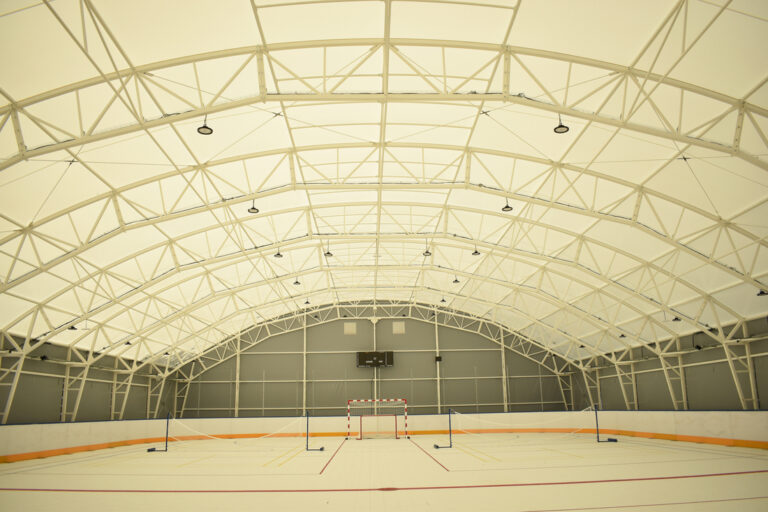
Acoustics. A tensioned absorbent ceiling covering roughly one third of a ceiling area approximately halves reverberation time. Extended across the ceiling and two walls, it approximately quarters it. In one New Zealand gymnasium with no previous acoustic treatment, reverberation fell from 6.9 seconds to 2.5.
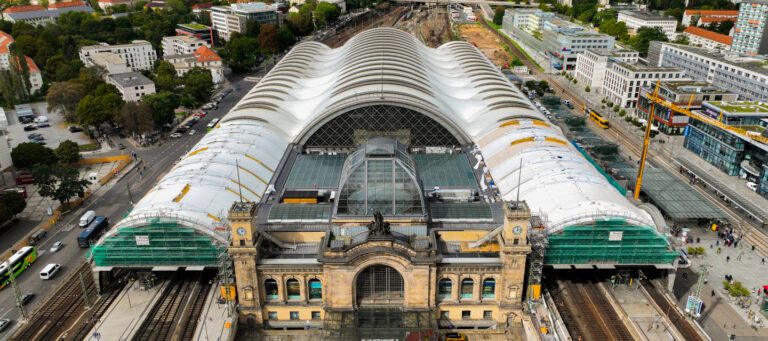
Daylight. Light can enter through the whole skin of a building rather than through openings cut into it. Glare is held at class 4 of EN 14501, the highest comfort class on that scale.
Heat and vapour. Internal temperature holds as external conditions move. The material stays vapour-permeable, so moisture does not condense inside the insulation.
The same evidence does not serve the same rooms.
An acoustic ceiling certified for a classroom. A screen holding glare and heat out of an office. A roof bringing daylight into a station concourse. Each use sets its own requirements, and the relevant proof changes with it.