
Dubai
United Arab Emirates
The Swiss Pavilion dressed with a non-combustible facade membrane (Dubai 2020)
ABOUT
Pushed back one year due to the Covid-19 pandemic, Expo 2020 Dubai finally opened its doors on October 1st, 2021. For the first World Expo held in an Arab nation, exhibitors hailing from more than 190 countries are showcased in a dedicated exhibition complex built on an expanse of desert.
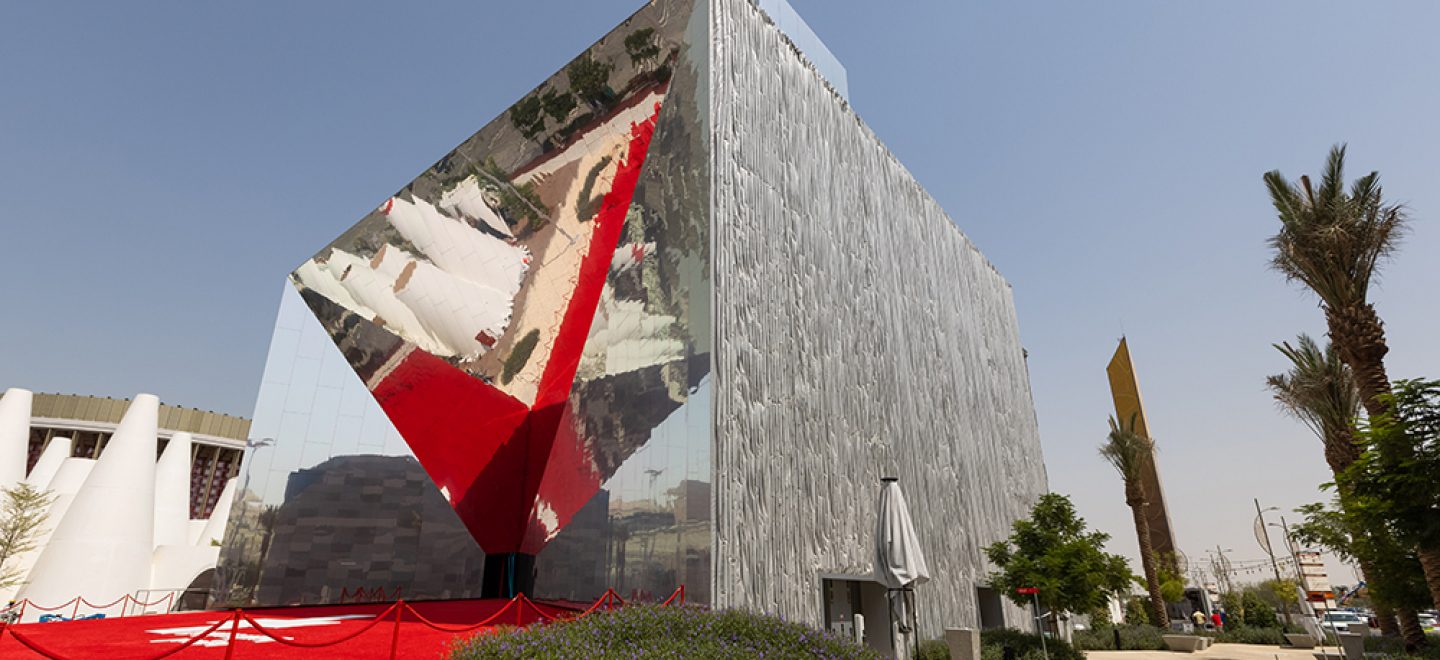
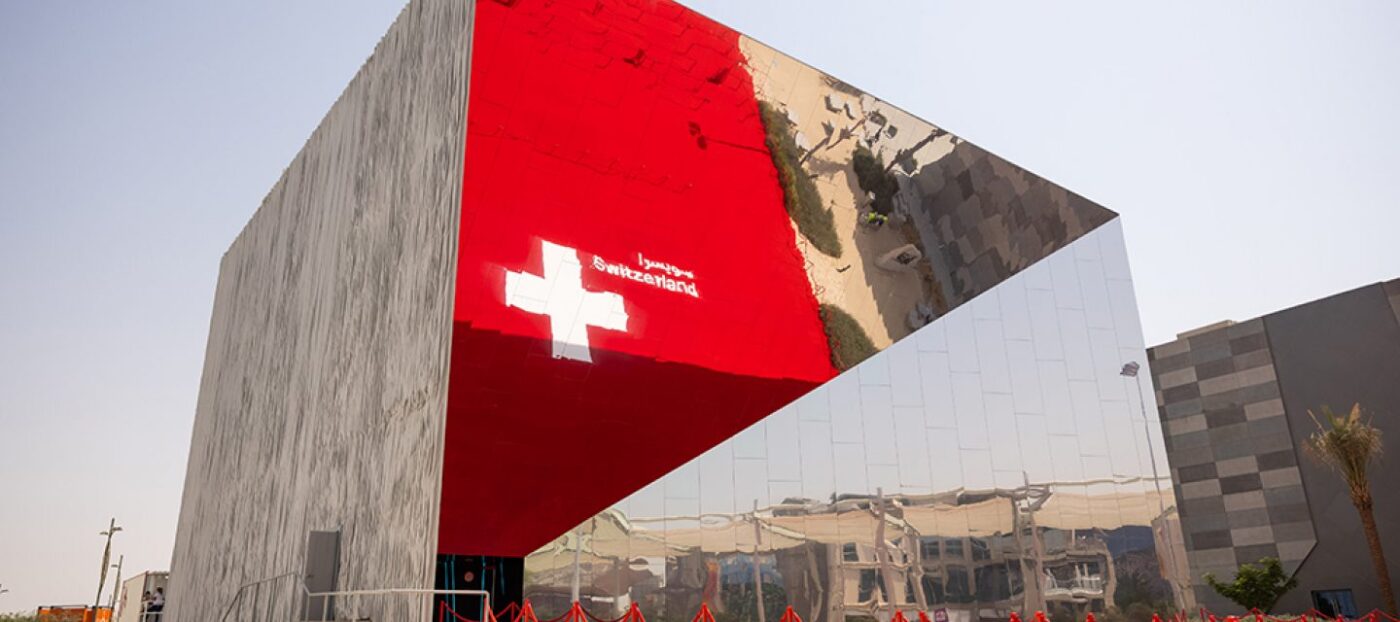
Proudly featured among these countries is Switzerland, whose spectacular pavilion design incorporates an extensive red carpet that seamlessly reflects onto the building’s cubist facade.
The Swiss Pavilion dons non-combustible facade membrane (Dubai 2020)
Pushed back one year due to the Covid-19 pandemic, Expo 2020 Dubai finally opened its doors on October 1st, 2021. For the first World Expo held in an Arab nation, exhibitors hailing from more than 190 countries are showcased in a dedicated exhibition complex built on an expanse of desert. Proudly featured among these countries is Switzerland, whose spectacular pavilion design incorporates an extensive red carpet that seamlessly reflects onto the building’s cubist facade. With a unique take on the event’s theme ‘Connecting Minds, Creating the Future’, Switzerland is promoting itself both as a destination of diverse natural experiences and a hub for technological innovation, as evidenced by projects and products developed by local higher education institutions, startups and innovative companies — among which Serge Ferrari which operates a factory in Eglisau, Switzerland.
Design inspired by Bedouin tents
Dubbed ‘Reflections’ and designed by a team consisting of architecture practice OOS, Bellprat Partners for the scenography and Lorenz Eugster for the landscape design, the Pavilion takes a cue from tents used by the Bedouin with a construction associating framing elements with a textile envelope. The resulting structure can be easily assembled and dismantled, effectively complying with the event’s sustainability objectives. And to top off the design, the pavilion’s facade has been dressed in a non-combustible membrane — Stamisol Safe One.
High tech architectural membrane
While the pavilion’s access points are carved into mirrored surfaces showing mirage-like illusions, the Northern and Southern facades feature a vast textile envelope with a distinctive metallic sheen and sophisticated draping. The material chosen in this case is a high tech architectural membrane offering proof of the quality of Swiss-made technical textiles for modern architectural applications.
New developments for greater safety
Stamisol Safe One is a non-combustible and light-diffusing membrane first launched commercially in 2019. It is manufactured by Serge Ferrari AG, in the town of Eglisau, Switzerland. ‘Since a number of tragic fires, including the one that ravaged the Grenfell Tower in London, have made clear just how vulnerable high-rises and other high-risk buildings can be, we have identified facade membranes as one of the major fire hazards due to curtain wall rear-ventilation’, explained Niklaus Zemp, CEO of Serge Ferrari AG. ‘That is why we have allocated a significant share of our R&D resources in developing a material that not only delivers the same outstanding weatherproofing properties as the Stamisol line, but also ensures effective protection against fire, in compliance with VKF 6q.3/RF1 ratings (Euroclass A2-s1,d0). And so our in-house team have developed a fibreglass textile coated with a special elastomer with light-diffusing properties.’
Safety for residents and users
What was once only achievable through thermal insulation and wall cladding is now also possible with tensile facades. It is now possible to design an expansive facade structure and secure an RF1 rating thanks to Stamisol Safe One, which:
— helps avoid the propagation of fire to ventilated areas,
— protects residents against toxic and dangerous fumes,
— reduces the risk of structural damage.
Project participants :
Architects: OOS AG
Staging: Bellprat Partner
Setting: Lorenz Eugster